Field
Technology
Machines that do what the first guess says they cannot.
42 entries
A fridge-bulb is still talking from the stars
Voyager 1’s transmitter radiates about 22 watts. From interstellar space, a 70-metre dish on Earth still locks onto it.
The blade runs hotter than its own melting point
In a modern jet engine the gas hitting the turbine is hotter than the melting point of the nickel alloy the blades are made of. The metal survives because it is cooled from the inside.
A lock everyone can close, and only you can open
Public-key cryptography lets you publish the method of locking a message. Strangers can lock things to you. They cannot unlock them.
A heater can move more heat than the energy it consumes
A heat pump often delivers two to four units of heat for one unit of electricity, because it is moving heat, not making it.
The pellet outran the laser, not the power plant
On 5 December 2022 a fusion target at the National Ignition Facility released 3.15 megajoules, more than the 2.05 megajoules of laser light that hit it. The building used far more energy than the pellet returned.
A four-kilometre ruler reads a fraction of a proton
LIGO’s arms are four kilometres long. A gravitational wave changes that length by a fraction of the diameter of a proton, a shift on the order of 10⁻¹⁸ metres.
The head flies a few nanometres above the disc
Inside a hard drive, the reader does not touch the platter. It flies on a film of moving air, or helium, a few nanometres up.
A reactor is steerable because some neutrons are late
About 0.65 percent of the neutrons from uranium-235 fission are born seconds later, from the decay of fission products. That delay is what control rods can keep up with.
A telescope the size of the Earth
The Event Horizon Telescope is radio dishes on separate continents, timed as one instrument. Its aperture, for the 2019 image of a black hole, was the planet.
A mirror on the Moon still answers
Retroreflectors left by Apollo crews return laser pulses sent from Earth. The round trip takes about two and a half seconds, and the distance is measured to about a millimetre.
The rocket is mostly fuel
On a typical launch to low orbit, on the order of nine tenths of the mass on the pad is propellant. The payload is a few percent.
Fissioning one gram matches tonnes of coal
Complete fission of one gram of uranium-235 releases about as much energy as burning around three tonnes of coal.
The finest chips are drawn by light that glass cannot pass
Extreme-ultraviolet lithography patterns chips with 13.5-nanometre light. Air absorbs it. Glass absorbs it. The lenses are mirrors, and the machine is a vacuum.
Noise has a speed limit
A channel with a given bandwidth and a given noise has a highest rate at which information can be sent with arbitrarily few errors. Shannon proved it in 1948. Modern links run close to it.
The navigation signal is quieter than the noise
The GPS signal at a phone’s antenna is weaker than the thermal noise in that antenna. The receiver finds it by correlating against a code it already knows.
A message can survive losing pieces of itself
Reed–Solomon codes add extra symbols so a receiver can rebuild ones that were erased or corrupted. Voyager used them. A compact disc uses them. A scratch need not be a click.
Light in a glass fibre travels at about two thirds of c
The refractive index of the glass in a communications fibre is about 1.5, so a signal in the fibre moves at about two thirds of the speed of light in vacuum.
Nearly all intercontinental traffic is on the seabed
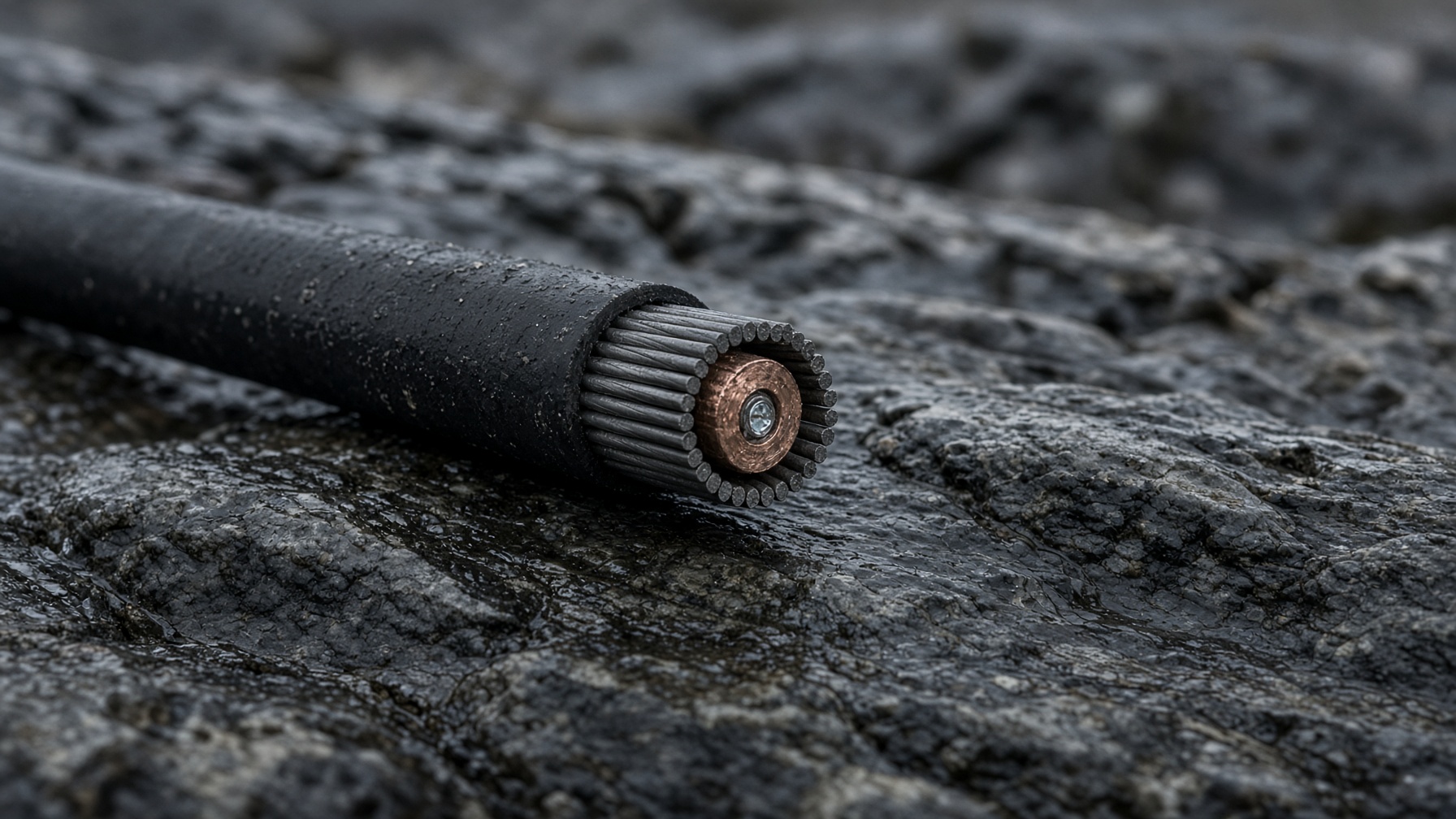
The large majority of data between continents travels on submarine cables, not by satellite. A modern cable is about as thick as a garden hose.
The amplifiers under the ocean are powered from shore
Repeaters on a submarine cable, sitting in the dark every fifty kilometres or so, are fed by direct current sent down a copper conductor from the landing stations. On the longest routes the voltage reaches the order of ten thousand volts.
The space telescope’s mirror is a hundred nanometres of gold
The James Webb Space Telescope’s mirror is beryllium coated with a layer of gold about 100 nanometres thick, thin enough to be almost nothing, chosen because gold reflects infrared.
Sunlight pushes, and a sail has flown on it
Light carries momentum. A sail can accelerate a spacecraft with no propellant. Japan’s IKAROS demonstrated it in interplanetary space in 2010.
A book has been written in DNA and read back
In 2012 a team encoded a book of about 53,000 words, and images, into DNA, stored it, and read it back with a few errors per million bits.
The scan never saw the slice
A CT scanner does not look at a slice of you. It measures how X-rays dim along many lines through the body, and a computer solves for the densities that would cast those shadows.
The white lamp starts out blue
A common white LED is a blue diode of gallium nitride under a phosphor that turns part of the blue into yellow. The eye reads the mix as white.
The electrons take the long way around
In a lithium-ion battery the ions cross the cell. The electrons cannot. They leave the terminal, do the work in your device, and come back the other terminal.
A laboratory clock would lose less than a second since the beginning
Optical atomic clocks have reached fractional uncertainties around 10⁻¹⁸. Kept up across the age of the universe, that fraction is less than a second.
One chip holds more switches than the Earth holds people
Published counts for the densest processors of the early 2020s run past a hundred billion transistors. About eight billion people are alive.
A cosmic ray can flip a bit
Neutrons from cosmic-ray showers, and alpha particles from the materials of the chip itself, flip bits in memory. At the scale of a fleet, this is a design constraint, not a curiosity.
The medicine can be a recipe the cell cooks
An mRNA vaccine delivers a temporary recipe, inside a droplet of fat, and the cell makes the protein. The recipe is not written into the genome.
The collider’s magnets are colder than the afterglow of the Big Bang
The Large Hadron Collider’s superconducting magnets run at 1.9 kelvin. The cosmic microwave background is 2.7 kelvin. The magnets are the colder of the two.
A shape can throw a radar echo away
A faceted or smoothly curved form can send a radar reflection somewhere other than back to the transmitter. That, more than a coat of paint, is what ‘stealth’ is.
The crystal is purified, then deliberately contaminated
Electronic-grade silicon is refined to roughly one stray atom in a billion. The behaviour of a chip comes from putting a chosen impurity back, at a dose of one atom in millions to billions.
One blade is a hundred metres long
The largest offshore wind turbines fly blades longer than 100 metres. A single blade is a hollow composite wing, and three of them sweep a circle wider than many runways are long.
To turn, a spacecraft spins a wheel the other way
A reaction wheel turns a spacecraft by spinning up in the opposite direction. Angular momentum is conserved, so the body rotates the other way. No propellant is used for the turn itself.
A fuel nozzle was grown, because a drill could not reach
The fuel nozzle of the LEAP jet engine is printed in metal, as one piece, with internal passages that a drill cannot reach because they do not open in a straight line.
A centimetre is a thirtieth of a nanosecond
Light in vacuum travels 299,792,458 metres a second, so in one nanosecond it covers about thirty centimetres. A lidar measures distance by timing that trip.
The beam steers without the antenna moving
A phased array points its beam by timing. Many small antennas, each delayed by a programmed amount, add in one direction and cancel in others. The panel stays still.
The body is imaged with radio, not with X-rays
MRI maps hydrogen nuclei in a magnetic field, using radio waves. The scan itself is not ionizing radiation. The word ‘nuclear’ was dropped from the name because it frightened people.
A spacecraft can steer by dead stars
In 2017, on the International Space Station, NASA’s SEXTANT experiment fixed its position from the X-ray pulses of millisecond pulsars, without using GPS.
The quantum computer is colder than space, and it forgets
Superconducting quantum bits run near 15 millikelvin, far colder than the cosmic microwave background. They lose their state in microseconds to milliseconds. Error correction, not the cold, is the unsolved part.
Bacteria keep a file of the viruses that attacked them
A CRISPR array is a list, written in DNA, of snippets taken from viruses. The cell uses the list to recognise those viruses and cut them. The gene-editing tool is that immune system, borrowed.
A horseshoe crab's blood is how drugs are checked for bacterial debris
Cells in Limulus blood clot when they meet endotoxin, a fragment of bacterial wall. That clot became the standard test for whether an injectable drug or a device was contaminated. A recombinant copy is now replacing the crabs.